This is a project that has been in the works for about 10 years. Here's a couple photos of the engine
on the dyno:
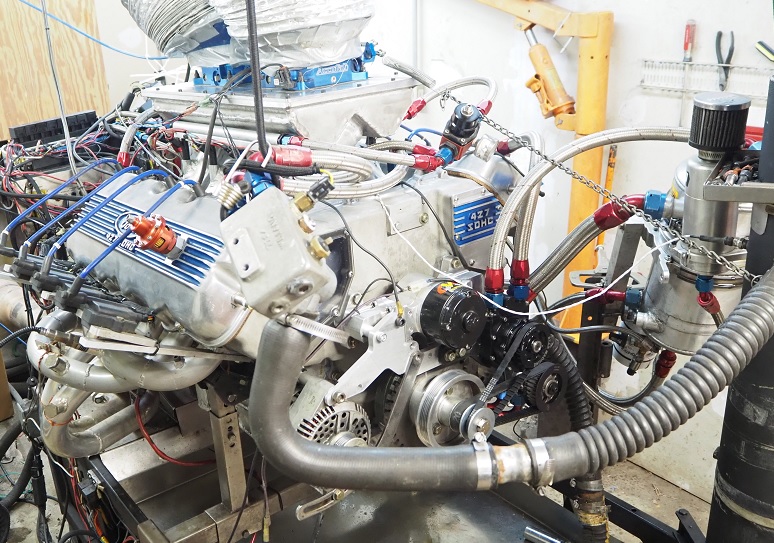
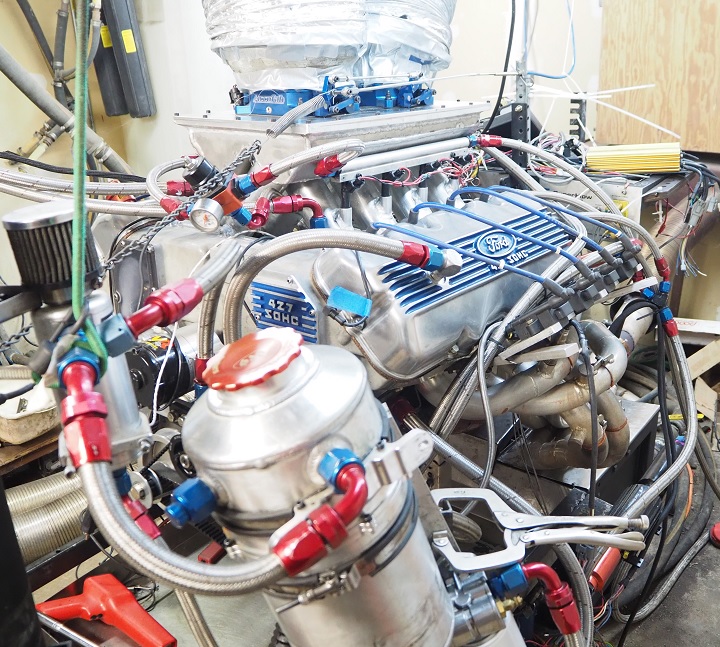
A couple pics of the best dyno pulls so far:
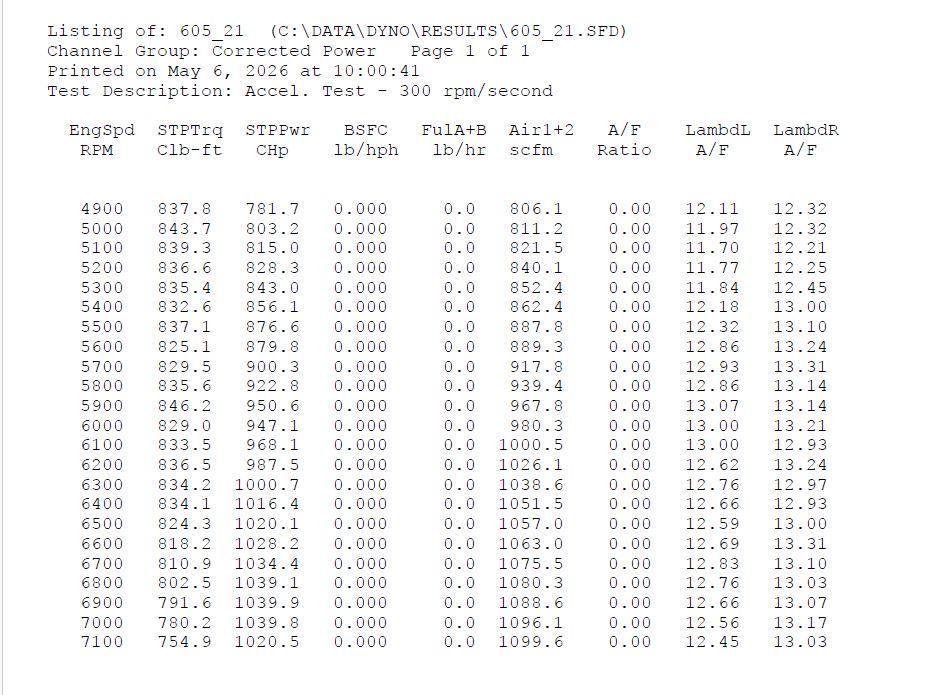
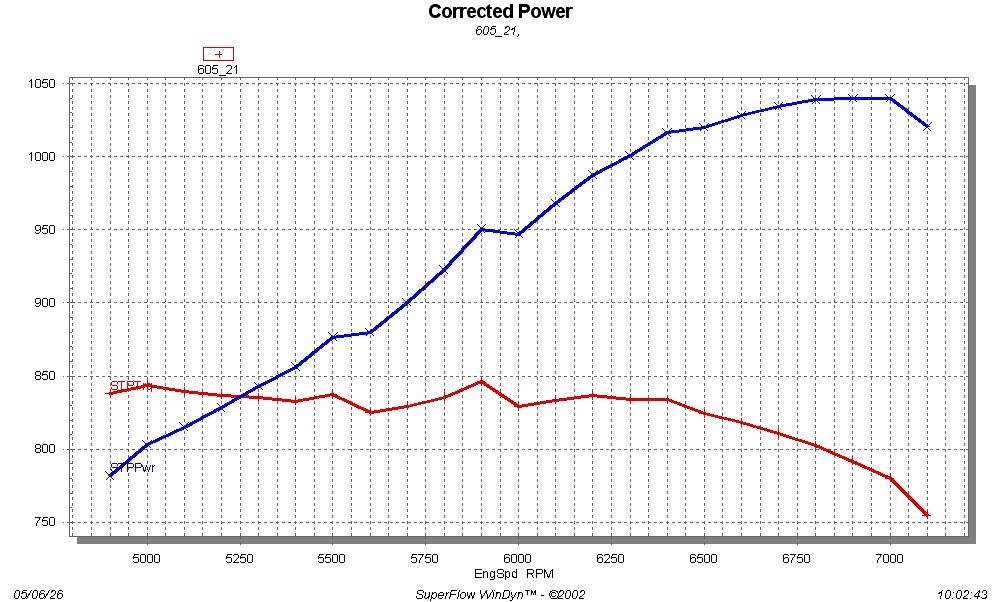
This is basically the same engine that I ran in my Galaxie at Drag Week in 2009, and that I
also ran in my Shelby clone in 2011, and 2014-2016. It is now 605 cubic inches and well over
1000 HP, but it has had a lot of problems along the way. Here is some history:
Back in 2009 I was still attending Drag Week every year and had found that the biggest cubic
inch engines made competing at the event and winning much more likely. With a lot of cubes
you can dial back the radical valvetrain and compression requirements and still make enough
power to be competitive, so I wanted to build an FE that was as large as possible. I had
just competed in Drag Week 2008 with my 520" SOHC Galaxie, but after repeated rocker arm failures
I had not been able to finish the event. T&D had just come out with their new rockers which
looked to be a lot better than the Dove, RAS, and Ford rockers I had been using. So I wanted
to head back to Drag Week with the Galaxie again, but with better rockers and more cubes.
I remember talking on the phone with Wes Adams about this, and he gave me the idea of spreading the
bore spacing of the block, in order to make a bigger bore. I was able to get a
partially machined aluminum block from Shelby, and had my local shop rebore it to 4.70" bore
spacing, up from the normal 4.63". With O-rings in the sleeves and copper head gaskets I was
able to go to a 4.500" bore. Along with a 4.6" stroke billet crank from Crower, the short
block was up to 585 cubic inches.
On the dyno the engine made 935 HP with Hilborn injectors converted to EFI, and at Drag Week
2009 the Galaxie ran low 9.50s and won the class. I made two passes on the last day, and was
lucky that the first one was good enough for the win, because I lost a T&D rocker on the second
pass. They had been brand new with only 50 miles on them when I left for the event.
I skipped Drag Week 2010, went back in 2011 with the engine in my 69 Shelby clone, but dropped
out after the first day due to water in the oil, related to the offset boring on the block (the offset
boring had opened up the casting on a couple cylinders, so that the back of two sleeves were exposed
to the water jacket. I used a chemical sealant to seal up the block, but it gave up between the first
and second tracks). Missed the event again in 2012, went with the Mach 1 in 2013, and back with the
SOHC and the Shelby clone in 2014. That year, the #5 Crower billet rod broke during the Drag Week
test and tune, and I was out of the event again.
The rod failure was a big surprise. I had not scrimped on the quality of the bottom end components
and wondered if it was just a defective rod, or if there was something else going on. I sent the rod
to Crower for analysis, and never heard a thing back. Eventually I had the block
repaired and rebuilt the engine, went back to Drag Week in 2015 and 2016, finishing first and second in
class respectively. I dealt with multiple rocker failures both years, and on teardown after 2016 I found
the #5 connecting rod cracked and ready to fail; I was lucky it hadn't let go. So obviously the
connecting rod that broke earlier was not defective; there was just something about the engine that
was hurting the #5 rod.
So, ten years ago I was faced with two major problems with the engine, the repetitive rocker arm
failures and the #5 connecting rod failures.
The rocker arm problem was addressed with my own design rockers, which I designed and started
building a few years later. They feature full time pressure oiling to a bushing in the roller wheel,
rather than relying on oil splash to needle bearings like all other SOHC rockers do. At this point
I'm pretty happy with that solution.
The #5 rod is a head scratcher though. Due to the spread bore spacing on the block, the #1, #4, #5, and #8
rods are not centered in the piston; they are offset by the amount of the change in bore spacing, 0.105".
But if this was the problem, why was the issue with the #5 rod only?
There was no good answer to this question. I worked with Blair on this and he ordered a Crower
crank for me that had the throws offset to line up properly with the spread bores. The hope was that this
would solve the rod problem. I also wanted to move up to a 4.75" stroke, so Blair also specified 2.100"
journals and small block Chev Crower rods that are supposed to be good for over 1000 HP. I'm a little
skeptical about that, but I guess we'll see; so far so good. With the 4.75" stroke and the 4.50" bore,
the engine is 605", probably the biggest cube FE that has ever gone together.
Various other projects came and went over the last several years, delaying my progress on this engine. I finally
started getting it together in February. In addition to the new crank and rods, and the rockers, I updated the
cams and valves for the engine, and put in a new dry sump pump (the last one was trashed by needle bearing shards
after rocker arm failures at Drag Week 2016).
It was good to finally get the engine up and running on the dyno. In 2016 it made 1002 HP, so it has shown a nice
increase in power so far. I have more dyno work to do on it, with some more tuning I think it might pick up a little
more; we will see.
Then, unfortunately, I have to tear it all down. I need to mag the rods and make sure that the crack on the #5 rod
is not coming back again. Another thing I recently learned, courtesy of Ferrea, is that titanium valves do not mesh well with
very hard valve seats. The heads I have were built with powdered metal seats, which are very hard. To be safe
I will get them replaced with ductile iron seats. I want to do everything possible to put this engine together
one last time, so I don't have to tear it apart for repairs again.
I put a post in the dyno section with all the details on this engine. With luck I will have it
reassembled and back in the car by the end of the summer. It would be nice to get back on the track again...
https://fepower.net/simplemachinesforum/index.php?topic=13176.0

